The Serra de Tramuntana is where Mallorca's driving experience changes completely. Coastal roads give way to hairpin bends, sheer drops and villages built into the mountainside, and the adjustment catches out plenty of first-time visitors.
Serra de Tramuntana driving rewards a bit of preparation. The roads themselves are safe and well maintained, but they demand a different pace and a different level of attention than most UK drivers are used to.
Here's what to expect on the road, and how to handle it with confidence.
Adjusting to Driving in Mallorca
For UK drivers, the biggest adjustment isn't the mountains themselves; it's the side of the road. Driving in Mallorca means sitting on the left side of the car while keeping to the right side of the road, and that switch takes most people a good hour or two to settle into properly.
Roundabouts tend to be the trickiest part of the adjustment. Give way to traffic already on the roundabout, and take a moment before pulling away if you're unsure which exit to take. Junctions can feel unfamiliar too, since the instinct to check the wrong direction first takes a little while to fade.
Once you're out of Palma and into quieter roads, the adjustment tends to settle into the background fairly quickly.
What Makes Serra de Tramuntana Driving Different
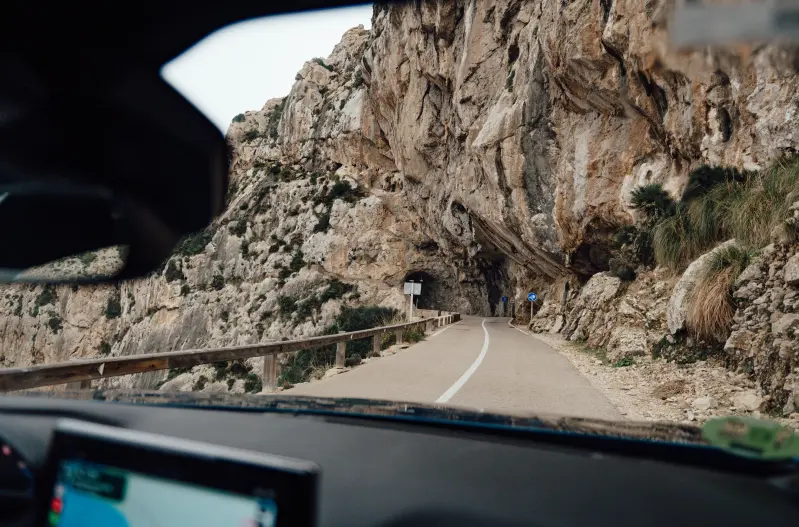
The Tramuntana mountains run along Mallorca's northwest coast, and the roads through them were built long before modern traffic volumes existed. Many sections are narrower than a typical UK B-road, with limited visibility around tight bends and very little room either side.
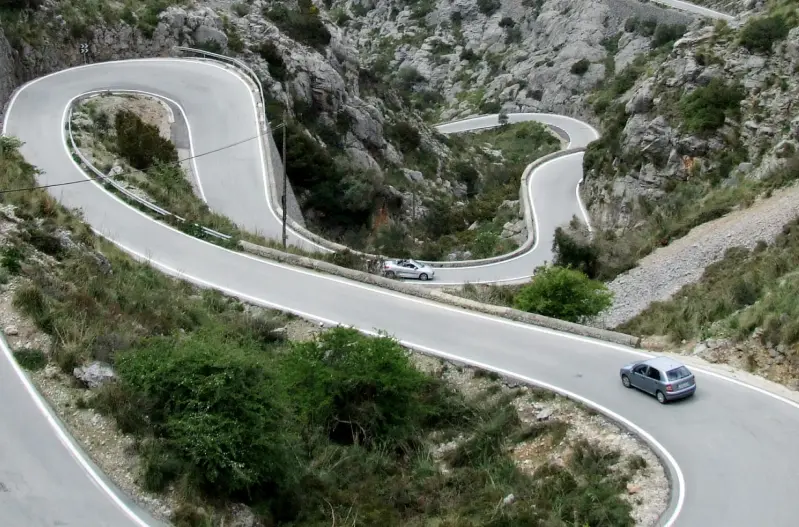
Hairpin turns are frequent throughout the Tramuntana, particularly on the Coll de Sóller pass and the spectacular road to Sa Calobra. Drivers will also encounter a number of tighter bends between Valldemossa and Deià, where visibility can be limited.
Taking these slowly matters more than it might seem, since oncoming traffic, including coaches and cyclists, often appears with little warning on the tighter corners.
Navigating Mallorca Mountain Roads: Hairpins, Passing Points and Cyclists
Mallorca mountain roads carry a mix of traffic that UK drivers aren't always used to sharing space with. Cyclists use these routes heavily, particularly in spring and sometimes autumn, when the Tramuntana's climbs draw riders from across Europe. Passing them safely means slowing down and giving as much width as the road allows, rather than squeezing past on a blind bend.
Passing points on the narrower stretches work on a simple principle: whoever reaches a tight section first has priority, and the other driver waits at the nearest pull-in. It's a system that works well once you're used to it, though it does require a bit more patience than most UK roads demand.
Coaches and delivery vehicles also use these roads regularly to reach the villages, so allowing extra space and time on blind corners is worth building into your pace from the start.
The Sóller Tunnel vs the Coll de Sóller Pass
Two routes connect the Tramuntana's western side to Sóller, and each offers a different experience.
The Sóller Tunnel is the quicker option, providing a direct route through the mountains and significantly reducing journey times. Since becoming free to use, it has become the most practical route for drivers travelling between Palma and Sóller.
The older route over the Coll de Sóller pass takes considerably longer, with a steady run of switchbacks climbing to a viewpoint that looks back across the valley. It's slower going, and not the road to take if you're in a hurry, but it's worth driving at least once during a longer stay.
Practical Tips for Your Tramuntana Road Trip
A few habits can make your Tramuntana road trip noticeably smoother.
- Fuel up before heading into the mountains, since stations thin out considerably once you're past Valldemossa. Mornings tend to be quieter on the roads and in the villages, particularly before the day-trip coaches arrive from Palma.
- Parking in villages like Deià and Valldemossa fills quickly during peak season, so arriving early or later in the afternoon gives more options and less circling for a space.
- Speed limits drop sharply through village centres, and enforcement is common enough that it's worth sticking to the posted signs rather than local traffic flow.
- Keep headlights on through the tunnels and any darker mountain stretches, and take blind corners at a pace that lets you stop safely if a cyclist or oncoming car appears.
- A car horn used briefly on the tightest hairpins is common practice locally, and it's a simple habit worth adopting for your own visibility on the blindest bends.
Getting the Right Car for the Mountains
A route through the Tramuntana puts more demand on a car than a flat coastal drive, with tight bends, steep gradients and the occasional steady climb all part of the route.
Picking up a car hire with Hertz in Palma means starting the drive with a vehicle suited to mountain roads from the outset, with the manoeuvrability needed for narrow village streets and hairpin turns built into the route ahead.